Table of Contents
- What Is a VA Loan Assumption?
- VA Loan Assumption Requirements
- How the Process Works
- Costs and Fees
- VA Entitlement Considerations
- FAQ
Yes, VA loans are assumable (per VA.gov) — and unlike most other mortgages, you don’t have to be a veteran to assume one. A qualified civilian buyer can take over a veteran’s existing VA loan, keep the original interest rate, and step into a payment that’s often hundreds of dollars per month lower than what a new mortgage would cost.
That’s the headline. The reality has more moving parts: the buyer still has to qualify with the lender, there’s a 0.5% funding fee, and the seller has to handle their VA entitlement carefully — or they could be locked out of using their VA benefit again until the assumed loan is paid off.
This guide walks through everything: who qualifies to assume a VA loan, what it costs, how long it takes, what the entitlement issue actually means, and how to figure out if it’s worth it for your specific deal.
What Is a VA Loan Assumption?
A VA loan assumption is when a buyer takes over the seller’s existing VA mortgage — including the remaining balance, the original interest rate, the payment schedule, and the rest of the term — instead of getting a new loan.
So if a seller has a VA mortgage at 2.75% with $280,000 left on it and 24 years remaining, a qualified buyer can step into that loan. They don’t apply for a new mortgage at 6.5%. They keep the seller’s terms.
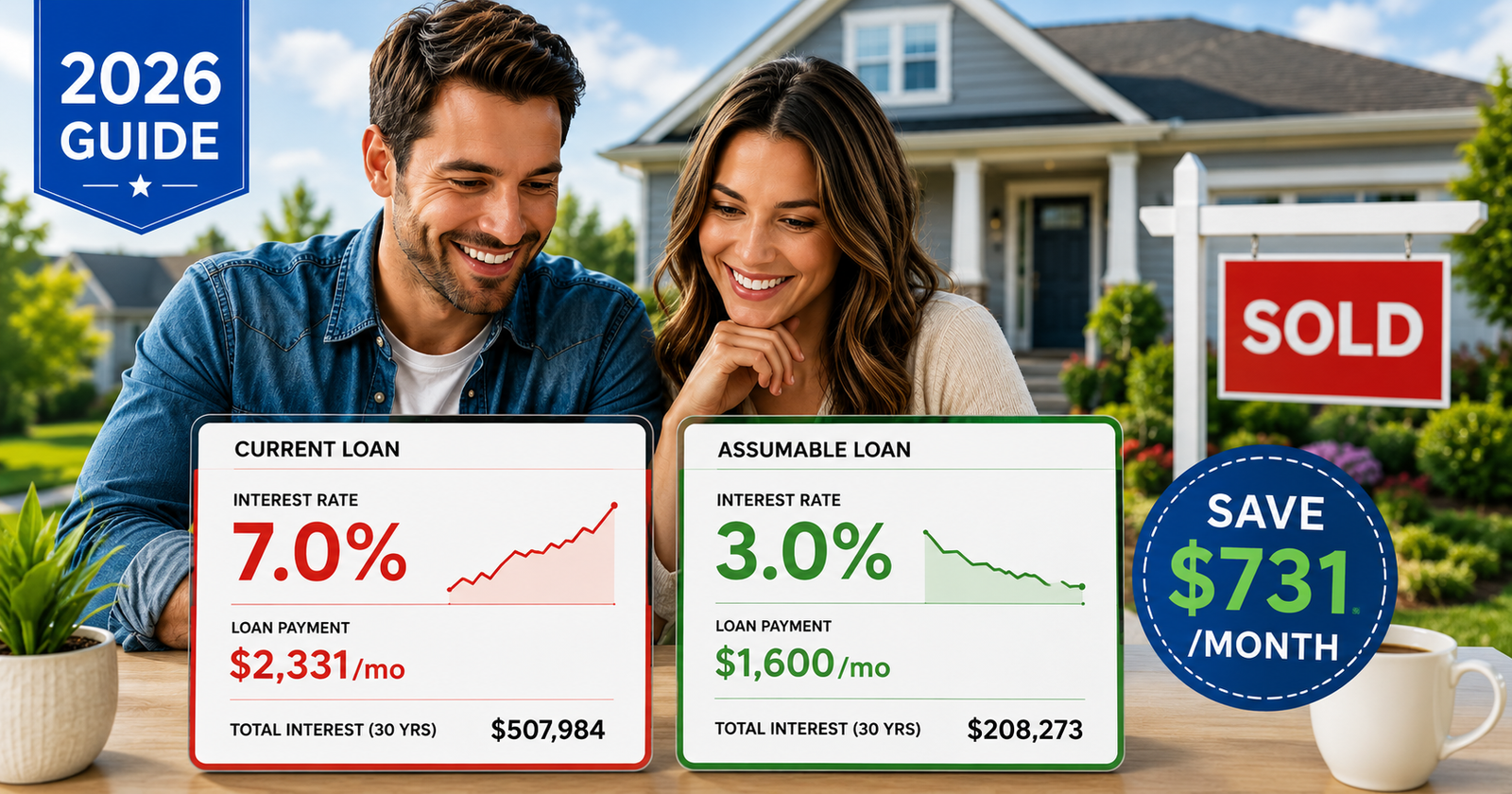
Compare that to a regular sale, where the seller’s loan gets paid off at closing and the buyer takes out a brand-new mortgage at today’s rate. With current rates near 6.5%, the difference between a 2.75% assumed VA loan and a new conventional loan can be $700–$1,100 per month on a $280,000 balance.
That math is why VA assumptions have gone from a quiet feature of the program to one of the most talked-about strategies in the 2026 housing market.
Are VA Loans Assumable? (The Direct Answer)
Yes — all VA-guaranteed loans are assumable with lender and VA approval. There are two important rules to know:
VA Loans Originated On or After March 1, 1988
These loans require both lender approval AND VA approval before they can be assumed. The buyer must qualify financially with the servicer, and the VA reviews the file. This covers virtually every VA loan in existence today.
VA Loans Originated Before March 1, 1988
These older loans are “freely assumable” — meaning the buyer can take over the loan without lender or VA approval. These are extremely rare today (the loans would be 38+ years old), but they do still exist.
One critical fact most people don’t realize: the buyer assuming a VA loan does NOT have to be a veteran. A civilian, an active-duty service member, or a surviving spouse can all assume a VA loan if they qualify with the lender. This makes VA assumptions more accessible than USDA assumptions, which require buyers to meet income and area eligibility rules.
VA Loan Assumption Requirements
To assume a VA loan, you’ll generally need to meet the following requirements:
Borrower Requirements
- Credit score: most lenders want 620 or higher, though some go as low as 580
- Debt-to-income ratio: typically 41% or lower
- Sufficient residual income (this is unique to VA — it’s the income left over each month after major expenses, and it must meet VA standards based on family size and region)
- Steady employment and verifiable income
- Intent to occupy the home as your primary residence
Property Requirements
- The home must be your primary residence
- The property must meet VA condition standards
- Standard appraisal generally not required for an assumption (this saves money and time)
Process Requirements
- Lender / servicer approval (the company currently servicing the loan)
- VA approval (for loans originated on or after March 1, 1988)
- Executed assumption agreement
- 0.5% VA funding fee on the unpaid loan balance
The residual income requirement is the part most people miss. You can have a 38% DTI that looks great on paper, but if your residual income doesn’t meet VA standards for your family size and region, the file can still get declined. This is unique to VA — neither USDA nor FHA has the same requirement.
How the VA Assumption Process Works (Step by Step)
Step 1: Find a Home With a VA Loan
This is harder than it sounds. Most listings don’t advertise that the existing loan is assumable, and many sellers don’t even realize their loan can be assumed.
If you’re working with a buyer’s agent, ask them to specifically inquire about loan type when reaching out to listing agents. If the listing mentions “VA loan,” “assumable financing,” or “low-rate government-backed mortgage,” that’s a green flag. For more on this, see How to Find Assumable Homes.
Step 2: Confirm the Loan Details
Before you go further, get the actual numbers from the seller or their agent:
- Current loan balance
- Interest rate
- Years remaining
- Current monthly principal and interest
- Loan servicer name and contact info
- Whether the seller is willing to substitute their VA entitlement (this matters for them, not you, but it affects whether they’ll do the deal)
Step 3: Apply With the Loan Servicer
You apply directly with whoever services the loan — not with a new lender of your choosing. This is a big difference from a normal home purchase. The servicer underwrites you the same way they would for a new VA loan: credit, income, residual income, employment, and DTI.
Expect to provide pay stubs, tax returns, bank statements, and a full mortgage application. The VA’s mandate is that lenders must process assumption applications within 45 days, but in practice timelines often run 45–90 days.
Step 4: Cover the Equity Gap
Here’s where most VA assumptions get complicated.
Say the home is priced at $400,000 and the loan balance is $280,000. You’re assuming the $280,000 loan, but you still owe the seller the other $120,000 — that’s their equity.
VA assumptions don’t include any built-in financing for that gap. You have to bring it in cash, get a second mortgage, or use some other financing. If the seller has built up significant equity over the years, the gap can be $100,000+, which is often more than buyers can come up with.
Run the numbers with the Assumable Mortgage Calculator before you go too far down this path. The math has to work for both the rate savings AND the cash you can bring.
Step 5: Approval and Closing
Once you’re approved by the servicer and (if applicable) the VA signs off, you sign assumption documents, pay the 0.5% funding fee and closing costs, and the loan transfers into your name.
Critically, the seller should request a Release of Liability from the lender at this stage. Without it, the seller remains personally liable for the loan even after you take over — meaning if you stop paying, their credit gets hit.
How Much Does a VA Loan Assumption Cost?
VA Funding Fee
The buyer pays a 0.5% VA funding fee on the unpaid principal balance at the time of assumption. On a $280,000 loan, that’s $1,400. This is dramatically lower than the funding fee on a new VA purchase loan (which can be 1.4%–3.6%).
Veterans exempt from the standard VA funding fee — including those receiving VA disability compensation, surviving spouses receiving DIC, and Purple Heart recipients — are also exempt from the assumption fee.
Lender / Servicer Processing Fee
Lenders with VA “automatic authority” are typically capped at $300 for the processing fee. Prior-approval files are often capped at $250. Some lenders charge an additional $900 “VA assumption processing fee.” Confirm the exact fees with your servicer before signing anything.
Closing Costs
Title insurance, recording fees, attorney fees (where required), and prorated taxes still apply. Budget 1.5–2.5% of the loan balance for total closing costs (this is generally lower than a new purchase because there’s no new appraisal and no origination fee).
Equity Gap
This is usually the biggest number. The difference between the home price and the loan balance has to come from somewhere — typically cash or a second mortgage.
The VA Entitlement Issue (Critical for Sellers)
This is the part that catches sellers off guard. If you’re a buyer, this section is mostly background — but if you’re a seller (or you’re working with a seller), this matters a lot.
VA entitlement is the dollar amount the VA guarantees on your loan. It’s what allows you to use a VA loan in the first place. When someone assumes your VA loan, your entitlement remains tied to that loan until it’s paid off — UNLESS the buyer is also a qualified veteran who is willing to substitute their entitlement for yours.
Translation: if a civilian assumes your VA loan, you cannot use a new VA loan to buy your next home until the assumed loan is paid off. That can lock you out of the VA benefit for decades.
If keeping your VA entitlement available is important to you as a seller, you’ll need to:
- Find a buyer who is also a qualified veteran
- Have them complete a Substitution of Entitlement (SOE) at closing
- Confirm in writing that the SOE is processed before you sign release documents
Many sellers happily accept a civilian buyer because the rate-based market advantage outweighs the entitlement concern. Others won’t. Both positions are valid.
VA vs. FHA vs. USDA Assumptions
All three government-backed loan types are assumable, but the rules differ:
| Feature | VA | FHA | USDA |
|---|---|---|---|
| Assumable? | Yes (all loans) | Yes (all FHA loans) | Yes (most loans) |
| Buyer must be eligible? | No (anyone can assume) | No special eligibility | Yes (income + area) |
| Upfront fee on assumption? | 0.5% funding fee | Small assumption fee ($500–$900) | 1% guarantee fee |
| Mortgage insurance after assumption? | None | MIP usually continues | Annual fee continues |
| Typical timeline | 45–90 days | 30–60 days | 45–90 days |
VA is the most flexible of the three for buyers — anyone can assume one, and there’s no ongoing mortgage insurance. The catch is the entitlement issue for sellers, which doesn’t exist with FHA or USDA.
If you’re researching the others, see USDA Loan Assumption Explained and FHA Assumable Mortgage Rules.
Is a VA Loan Assumption Worth It?
It depends on three numbers:
- The seller’s VA loan rate vs. today’s market rate
- The size of the equity gap (how much cash you need)
- Total monthly savings over 12, 24, and 36 months
As a rough rule: if the seller’s rate is more than 1.5% below today’s rate, and you can comfortably cover the equity gap, an assumption usually pencils out. The savings can be substantial — VA loans never require mortgage insurance, which alone saves buyers hundreds per month compared to a new FHA or low-down conventional loan.
The lack of mortgage insurance is the underrated piece. On a $280,000 conventional loan with less than 20% down, PMI runs $100–$200/month. On an FHA, MIP runs even higher and continues for the life of the loan. A VA assumption skips both. That’s pure savings on top of the rate advantage.
Run your specific deal through the Assumable Mortgage Calculator to see actual numbers.
VA Loan Assumption FAQ
Are VA loans assumable?
Yes. All VA-guaranteed loans are assumable with lender approval, and VA approval is required for loans originated on or after March 1, 1988. The buyer must qualify financially with the servicer and meet credit, income, and residual income standards.
Can a non-veteran assume a VA loan?
Yes. VA loans can be assumed by anyone — veterans, active-duty service members, surviving spouses, or civilians — as long as they qualify with the lender. The buyer does not need their own VA eligibility.
How much is the VA assumption funding fee?
The VA funding fee for an assumption is 0.5% of the unpaid loan balance. On a $280,000 loan, that’s $1,400. This is significantly lower than the 1.4%–3.6% funding fee on a new VA purchase loan.
How long does a VA loan assumption take?
Typically 45 to 90 days from application to closing. The VA mandates that lenders process assumption applications within 45 days, but real-world timelines often run longer due to documentation, underwriting, and VA review.
Do I need to be a veteran to assume a VA loan?
No. Anyone who qualifies financially with the lender can assume a VA loan. This is one of the most flexible features of the VA loan program and a key reason VA assumptions are popular in high-rate markets.
What credit score do you need to assume a VA loan?
Most servicers want a minimum credit score of 620, though some will accept 580 with strong compensating factors. VA’s residual income requirement is often the bigger hurdle than the credit score itself.
What happens to the seller’s VA entitlement after an assumption?
The seller’s entitlement remains tied to the assumed loan until it’s paid off — unless the buyer is also a qualified veteran who completes a Substitution of Entitlement at closing. If a civilian assumes the loan, the seller cannot use a new VA loan until the assumed loan is paid off.
Does a VA loan assumption require an appraisal?
Generally no. Standard VA assumptions don’t require a new appraisal, which saves time and money compared to a new purchase. The lender may still verify property condition, but the formal appraisal step is typically skipped.
Is mortgage insurance required on an assumed VA loan?
No. VA loans never require mortgage insurance, including after assumption. This is a major advantage over FHA assumptions (where MIP usually continues) and conventional loans with less than 20% down.
Can the seller stay on the loan after assumption?
Only if they fail to request a Release of Liability. By default, the seller remains personally liable for the mortgage until they get a written release from the lender. Sellers should always request the release at closing — without it, they’re on the hook if the buyer defaults years later.
Final Thoughts
VA loan assumptions are one of the most powerful tools in the current housing market. The combination of low locked-in rates, no mortgage insurance, and the ability for anyone to assume them creates real opportunity for buyers — and gives sellers a meaningful marketing advantage in a market where most homes need a 6%+ rate to be financed.
The biggest mistakes people make: not running the numbers carefully on the equity gap, missing the residual income requirement, and (for sellers) not protecting their VA entitlement properly. Avoid those three and you’ll have a clear picture of whether a VA assumption makes sense.
Use the Assumable Mortgage Calculator to compare your specific deal against a new loan at today’s rates.