Table of Contents
If you’re buying a home in today’s high-interest market, you may be leaving thousands of dollars on the table without knowing it.
An assumable mortgage lets you take over a seller’s existing home loan — including their lower interest rate. Instead of taking out a brand new mortgage at today’s rates, you step into their loan and keep paying it under the original terms.
This guide covers everything you need to know about assumable mortgages in 2026: how they work, who qualifies, how much you can save, and exactly how to find one.
Use the calculator below to see your potential savings instantly.
Try the Assumable Mortgage Calculator →
What Is an Assumable Mortgage?
An assumable mortgage is a specific type of home loan that can be transferred from the seller to the buyer. When you assume a mortgage, you take over the seller’s remaining loan balance, their interest rate, and their loan terms.
This means if the seller locked in a 3% rate in 2020, you could take over that loan and keep paying 3% — even if today’s rates are 7% or higher.
How It Works in Simple Terms
- Seller has an existing FHA, VA, or USDA mortgage
- Buyer applies to take over that loan from the lender
- Lender approves the buyer based on credit and income
- Buyer assumes the loan — same rate, same remaining balance
- Seller is released from liability (if formally approved)
How Much Can You Save With an Assumable Mortgage?
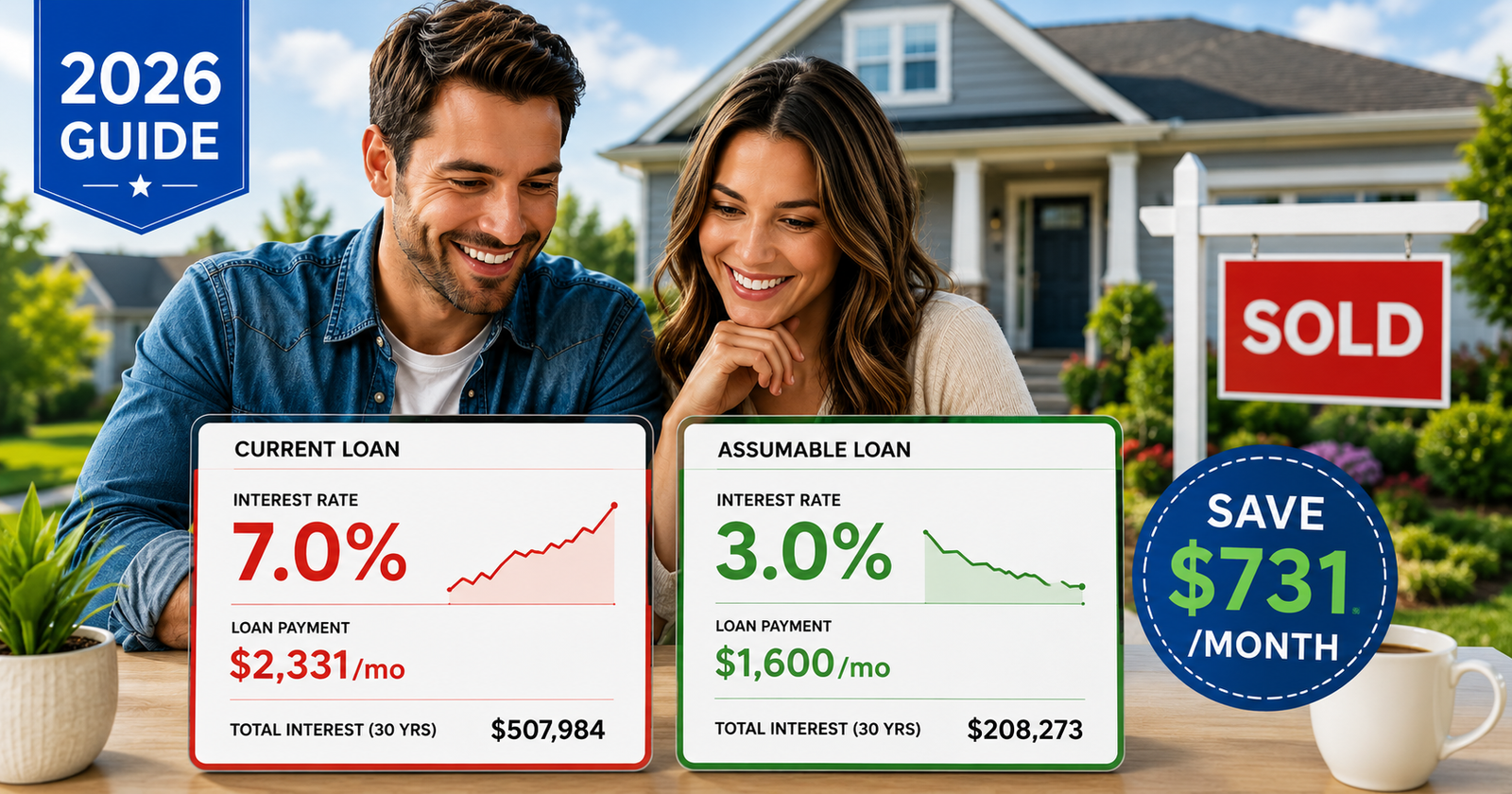
The savings potential is substantial. Here’s a simple example:
| Scenario | Loan Amount | Interest Rate | Monthly Payment |
|---|---|---|---|
| New mortgage (today’s rate) | $300,000 | 7.0% | $1,996 |
| Assumed mortgage (seller’s rate) | $300,000 | 3.0% | $1,265 |
| Monthly Savings | $731/month | ||
| Annual Savings | $8,772/year |
Over a 30-year loan, that difference can add up to hundreds of thousands of dollars.
Calculate Your Exact Savings →
Types of Assumable Mortgages
There are three main types of government-backed loans that are assumable:
1. FHA Loan Assumptions
FHA loans are the most common type of assumable mortgage. They are insured by the Federal Housing Administration and are available to buyers with lower credit scores and smaller down payments.
Key facts about FHA loan assumptions:
- The buyer must meet FHA credit and income requirements
- A minimum credit score of 580 is typically required
- The lender must approve the assumption
- The original borrower may remain liable if not formally released
Read the Full FHA Assumable Mortgage Rules →
2. VA Loan Assumptions
VA loans are issued to eligible veterans and active-duty military members. They often carry some of the lowest interest rates available, making them highly valuable to assume.
Key facts about VA loan assumptions:
- VA loans can be assumed by non-veterans
- The assuming buyer must qualify financially
- If a non-veteran assumes the loan, the seller’s VA entitlement may remain tied up
- VA assumptions require lender and VA approval
Read the Full VA Loan Assumption Guide →
3. USDA Loan Assumptions
USDA loans are available for rural and some suburban properties. Like FHA and VA loans, they are government-backed and assumable with lender approval.
Key facts about USDA loan assumptions:
- The property must be in an eligible rural area
- Buyer must meet USDA income eligibility requirements
- Lender and USDA approval are both required
- Assumption fees may apply
Read the Full USDA Loan Assumption Guide →
How to Find Assumable Homes
Finding a home with an assumable mortgage requires a slightly different search strategy than a typical home purchase.
Here’s where to look:
- Real estate listings that specifically note “assumable mortgage”
- VA and FHA listings — these loans are assumable by law
- Your real estate agent — ask them to filter for government-backed loans
- Assumable mortgage platforms — dedicated marketplaces exist for this
- Direct seller outreach — ask sellers directly about their loan type
The key is knowing which homes have government-backed loans before you start making offers.
Read: How to Find Assumable Homes →
Is Assuming a Mortgage Worth It?
For most buyers in a high-rate environment, assumable mortgages with a rate below today’s market rate are absolutely worth it. However, there are important factors to consider.
Pros of Assuming a Mortgage
- Lower monthly payments
- Significant long-term savings
- Lower closing costs in some cases
- Faster approval process (in some situations)
Cons of Assuming a Mortgage
- You may need a large down payment to cover the equity gap
- The process can take longer than a traditional mortgage
- Not all lenders are experienced with assumptions
- Limited inventory of assumable homes
Read: Are Assumable Mortgages Worth It? →
The Assumption Process Step by Step
Here is a general overview of how the assumption process works:
- Find an assumable home — Identify a property with an FHA, VA, or USDA loan
- Make an offer — Include assumption terms in your purchase agreement
- Apply with the lender — Submit your financial documents to the existing lender
- Get approved — The lender reviews your credit, income, and debt
- Close the deal — Sign the assumption agreement and take over the loan
- Seller is released — The lender formally releases the seller from liability
The timeline varies but typically runs 45 to 90 days depending on the lender.
Working With a Lender
Not all lenders are experienced in processing loan assumptions. Working with the right lender can make a significant difference in how smoothly your assumption goes.
Things to look for in an assumption lender:
- Experience with FHA, VA, or USDA assumptions
- Clear communication about timelines
- Transparent fee structures
- A track record of closed assumptions
Additional Resources
Looking to go deeper? Here are more tools and guides available on this site:
- Assumable Mortgage Calculator — Calculate your monthly payment savings instantly
- FHA Assumable Mortgage Rules — Full FHA assumption guidelines
- VA Loan Assumption Guide — Everything veterans and buyers need to know
- USDA Loan Assumption Explained — Rural loan assumption rules
- How to Find Assumable Homes — Step-by-step search strategy
- Are Assumable Mortgages Worth It? — A full pros and cons breakdown
For official guidelines on assumable mortgages, you can also reference the U.S. Department of Housing and Urban Development (HUD) and the Consumer Financial Protection Bureau (CFPB) guide on assumable mortgages.
Frequently Asked Questions
Who qualifies to assume a mortgage?
Qualification requirements depend on the loan type. Generally, you need a qualifying credit score, stable income, and an acceptable debt-to-income ratio. FHA, VA, and USDA assumptions each have specific eligibility criteria.
How long does it take to assume a mortgage?
The assumption process typically takes 45 to 90 days, though this can vary by lender and loan type.
Will assuming a mortgage affect my credit?
The lender will pull your credit as part of the qualification process. Once approved, the assumed loan will appear on your credit report like any other mortgage.
What happens to the seller after assumption?
Once the lender formally releases the seller, they are no longer responsible for the loan. This is called a novation or release of liability.
Start Calculating Your Savings
Ready to see exactly how much you could save by assuming a mortgage?
Use the Free Assumable Mortgage Calculator →
Or connect with one of our lender partners who specializes in mortgage assumptions:
Last updated: 2026 | Assumable Mortgage Calculator | Information provided for educational purposes only. Consult a licensed mortgage professional before making financial decisions.